How to Scale Hiring without Increasing Recruiters?


Why Hiring Breaks at Scale?
When organizations move into high volume recruiting, three bottlenecks usually appear.
Resume Overload
A single role can attract hundreds of applicants.
Even experienced recruiters struggle to quickly determine who is truly relevant from a stack of polished resumes. Surface-level signals often hide real capability gaps.
Resume review becomes slow and increasingly unreliable.
Manual Screening
Once resumes are reviewed, recruiters still need to verify basics.
They end up reaching out to candidates individually to confirm things like:
- actual role experience
- availability
- interest in the opportunity
- salary expectations
This step often consumes a large portion of a recruiter’s day.
First-Round Interview Bottleneck
Early interviews are necessary, but they rarely scale.
Recruiters ask the same introductory questions repeatedly to 100’s of candidates establish basic signal:
- understanding of the role
- problem-solving approach
- communication clarity
These calls help identify qualified candidates, but they also create a major time bottleneck.
In high volume hiring, recruiters can quickly become overwhelmed by early-stage work.
The False Solution: Hiring More Recruiters
When hiring volume increases, companies often respond with a straightforward solution:
Hire more recruiters.
At first glance, it makes sense. More hiring demand should mean more recruiting capacity.
But this approach creates new problems.
Recruiting teams grow quickly, which increases operational costs. Coordination between recruiters becomes harder. Screening standards become inconsistent across the team.
Most importantly, the core workflow remains unchanged.
Recruiters still spend large amounts of time:
- reviewing resumes
- verifying basic information
- running first-round interviews
Adding more recruiters simply multiplies the same manual process.
Companies end up scaling recruiting labor, not recruiting systems.
The Real Solution: High Volume Hiring Software
Organizations that smartly hire at scale approach the problem differently.
Instead of expanding recruiter headcount indefinitely, they identify what shouldn’t be done by humans anymore.
These are then handled by AI.
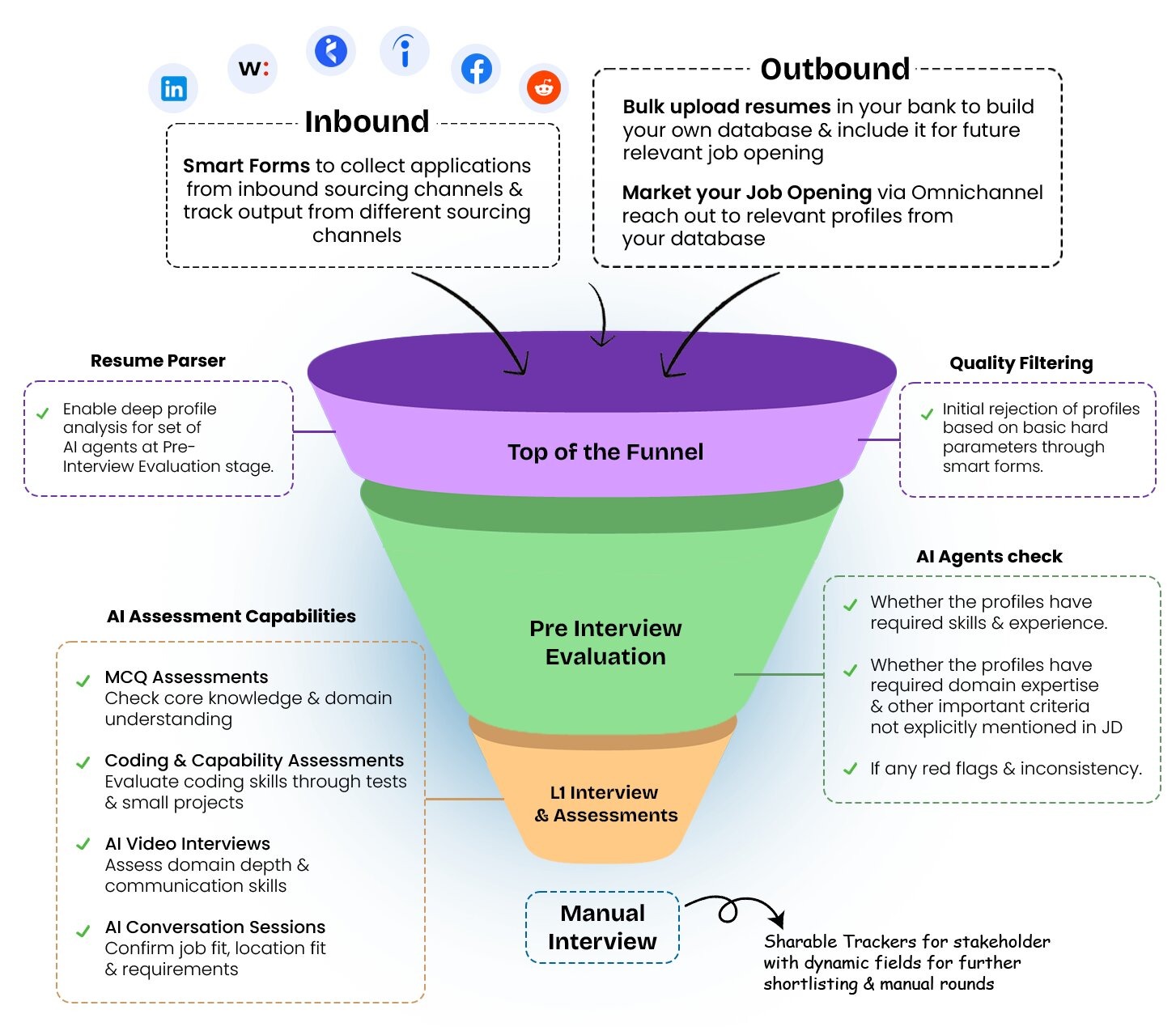
A scalable high volume hiring software like Talowiz typically operates through four layers.
Intake Layer
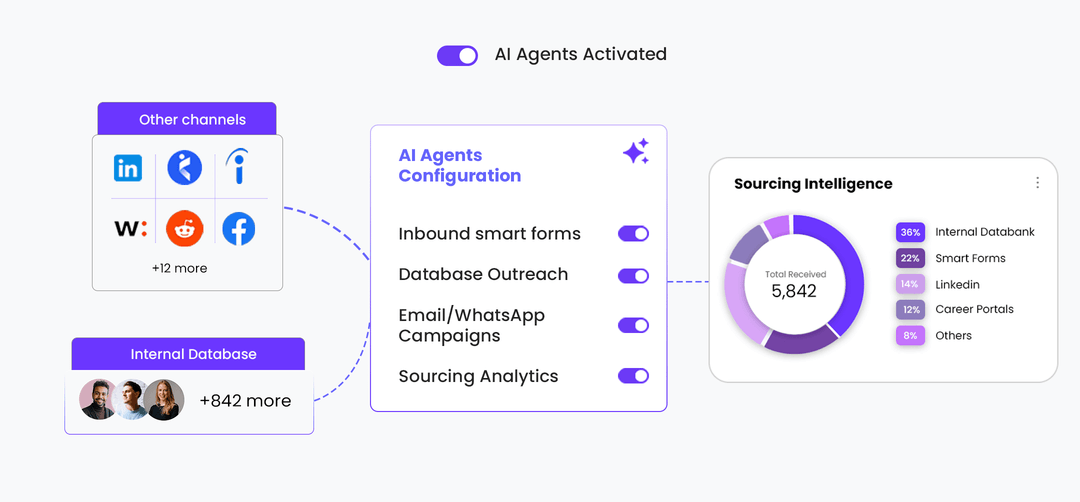
The first challenge in high volume hiring is managing candidate inflow.
Candidates arrive from many sources:
- job boards
- career pages
- referrals
- internal databases
Without structure, recruiters end up jumping between systems and tracking candidates manually.
Talowiz intake layer consolidates candidates from all sources into a unified pipeline. Instead of scattered applications, it’s now organized under one roof.
Screening Layer
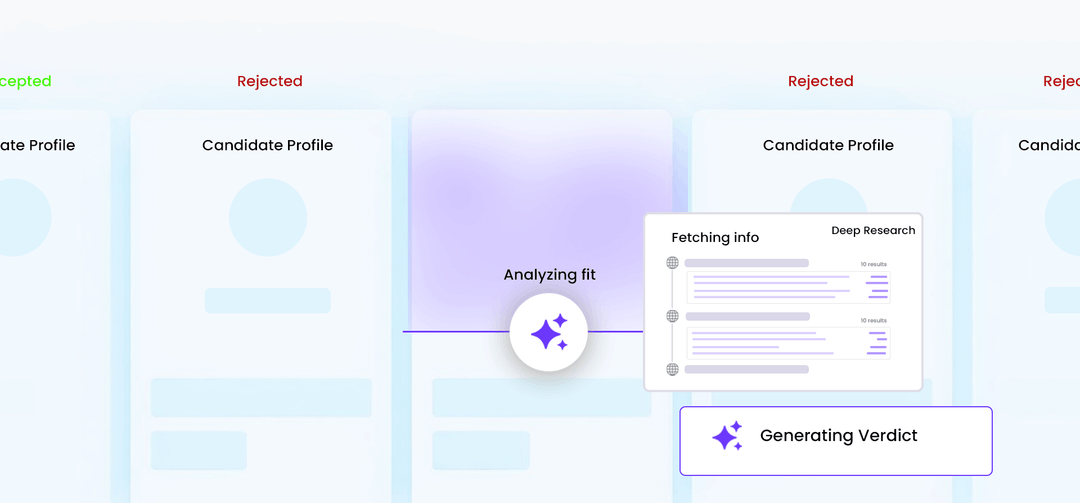
Once candidates enter the system, the next step is identifying who actually fits the role.
Instead of relying on manual resume review, Talowiz uses automated screening by AI Agents.
This includes mechanisms such as:
- rule-based filtering
- Candidate Relevance
- checklist validation for required criteria
- Probable Red flags
The goal is simple: remove obvious mismatches before recruiters spend time reviewing profiles.
Validation Layer
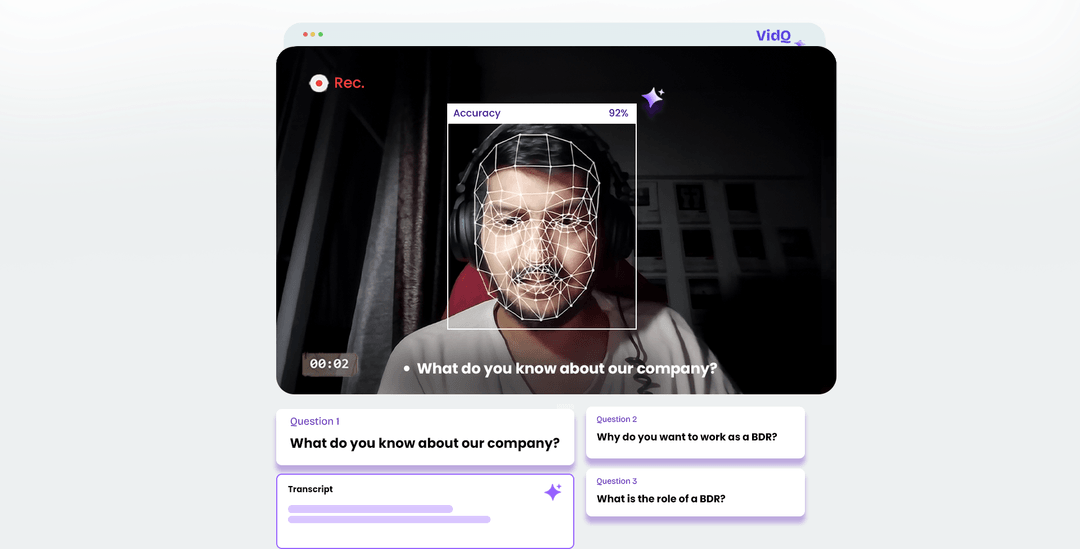
Even after screening, resumes still don’t reveal the full picture.
This is where structured evaluation becomes important.
Talowiz validate candidate readiness through it’s inbuilt AI Agents such as:
- skill assessment Agent
- Technical Interview Agent
- AI Video interview Agent
- Background verification Agent
These steps replace the traditional bottleneck of manual first-round interviews.
Instead of recruiters calling candidates one by one, candidates complete structured evaluations that produce clear signals.
This is where automated interviews begin to change how hiring works.
Candidates demonstrate their thinking, communication, and domain knowledge before recruiters invest time.
Pipeline Layer
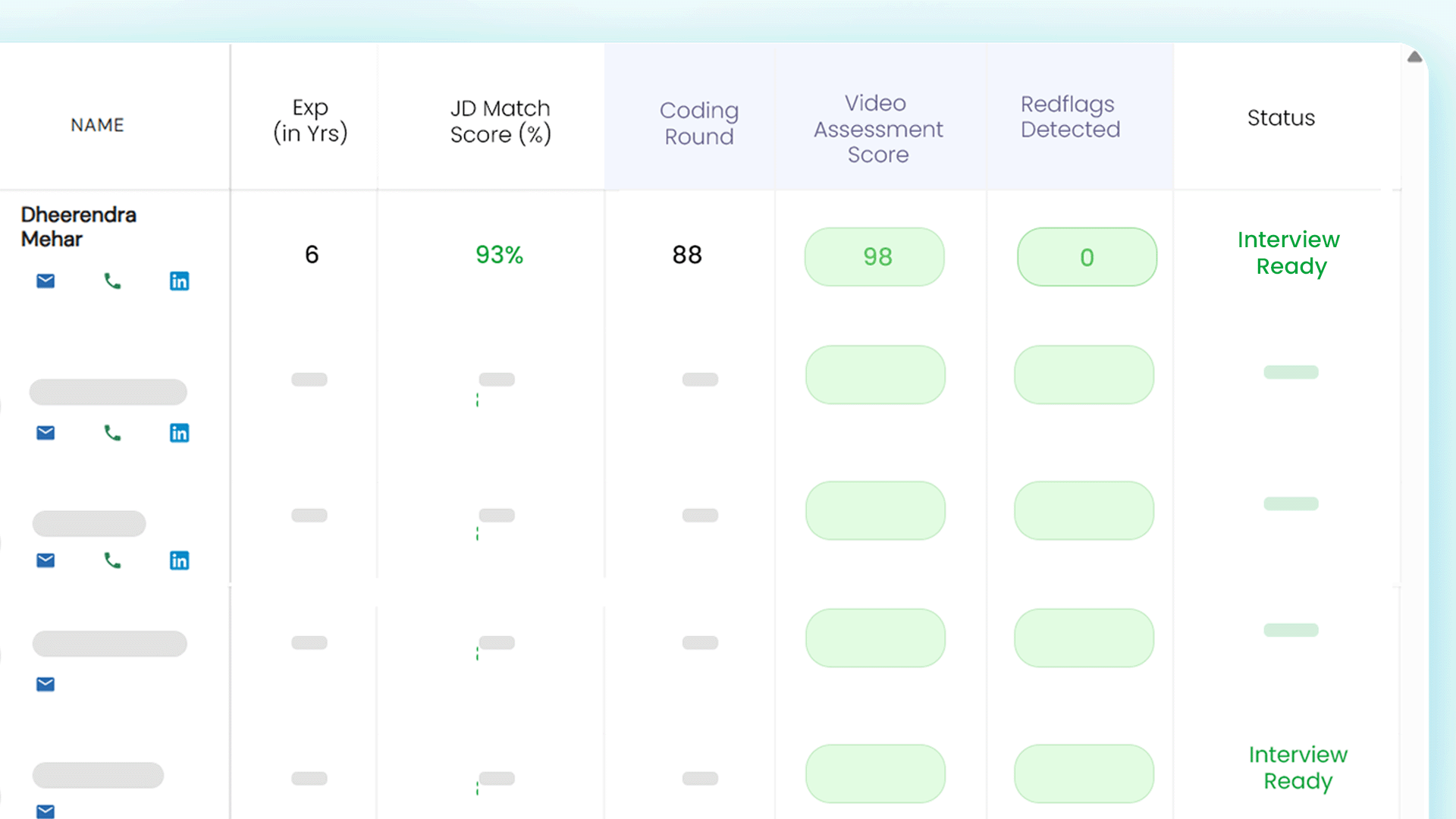
After screening and validation, the system routes the strongest candidates forward.
Instead of receiving a list of raw applicants, recruiters see candidates who have already been evaluated.
They can review:
- structured scorecards
- interview insights
- skill signals
- readiness indicators
At this point, recruiters are not filtering noise.
They are reviewing qualified candidates who actually qualify for an interview.
What Recruiters Should Actually Do?
Recruiters bring the most value to hiring when they focus on the human side of the process.
Things machines cannot replicate.
That includes:
- understanding candidate motivation
- assessing deeper team and cultural fit
- building relationships with strong candidates
- guiding candidates through complex decisions
- negotiating offers and closing hires
These tasks require judgment, empathy, and experience.
They are very different from scanning resumes or repeating introductory interview questions.
When early-stage evaluation is automated, recruiters spend their time where it matters most.
Speaking with candidates who already show a real signal.
Not everyone who applies.
Closing Insight
Companies that succeed in high volume hiring do not simply add more recruiters.
They rethink how hiring systems work.
Instead of starting with raw resumes, they build infrastructure that filters, evaluates, and validates candidates before recruiters step in.
The result is a hiring workflow where recruiters begin with qualified candidates rather than an overwhelming pool of applicants.
Hiring does not scale with headcount alone.
It scales with the systems that support it. Get a demo of Talowiz